Have you ever wondered why a good business suit of high quality maintains its sharp lines despite numerous washings? Or how can a shirt collar be crisp though it is moved daily? The solution is not the outward cloth but the interior one.
This inner covering is known as interlining. It helps to hold the garment and provide strength. In its absence, most structured clothing would soon collapse out of shape.
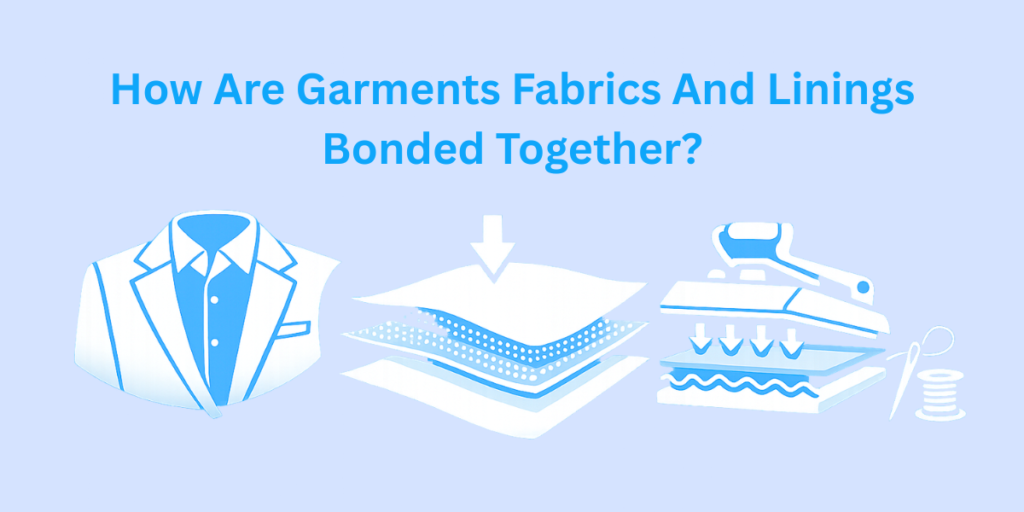
Bonding in the garment business is not just glue. It is a technological procedure that combines layers to enhance shape and strength. Bonding is crucial, regardless of whether you are making clothes in bulk or customized items.
In this guide, we discuss the woven and non-woven interlinings. We describe the nature of bonding and its significance. You will find how Longhel Interlining enhances the quality of garments, using thermoplastic resin for high-level fusion.
What Is Garment Bonding And Why Does It Matter?
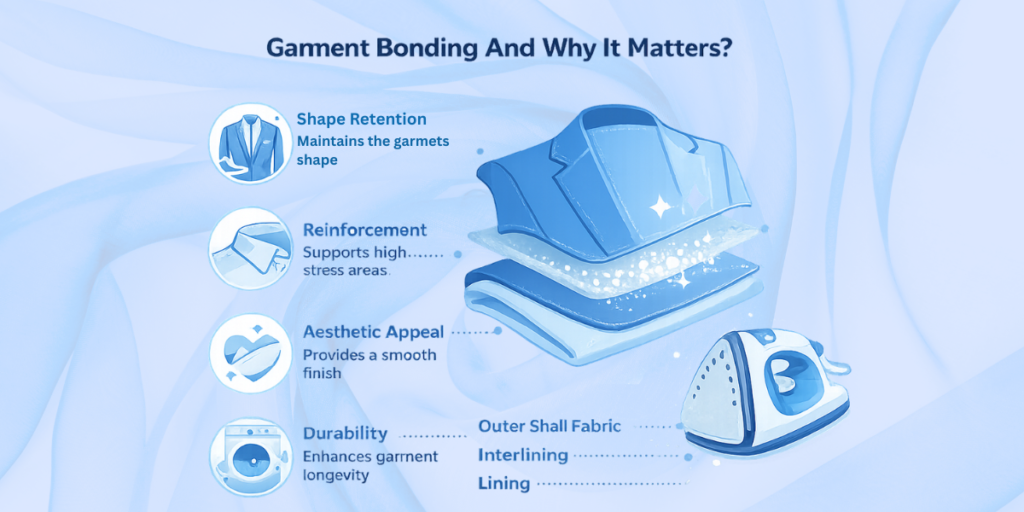
Bonding is the process of connecting the base fabric, referred to as the shell, and a second material, such as interlining or lining. It is the skeleton of a garment. In its absence, clothes are too soft to hold buttons, zippers, or fitted shoulders.
Why Do We Bond Fabrics?
- Shape Retention: It eliminates the tendency of the garment to lose its shape with time.
- Reinforcement: It provides a supporting effect to the high stresses like necklines, cuffs, and pocket openings.
- Aesthetic Appeal: Bonding offers an internal smooth finish.
- Durability: The garment is made by bonding a layer to ensure that it withstands multiple industrial washings or dry cleaning.
The Components: Fabrics, Linings, And Interlinings
In order to comprehend bonding, we need to name the players. All the garments are made of various materials.
1. The Shell Fabric
This is the external side of the garment. It may be a heavy wool of a business suit or a lightweight silk of a lady’s fashion.
2. The Lining
Linings are usually loose clothing. They offer protection to the skin and also make the clothing more comfortable to wear. They are hardly connected on the whole surface.
3. The Interlining (The Bonding Star)
It is the layer between the lining and the shell. The magic takes place here. There are two major types of interlinings, which include the Fusible and Non-Fusible.
| Interlining Type | Bonding Method | Best Use Case |
| Fusible Woven | Heat and Pressure | Jackets, Suits, Shirts (DS Series). |
| Non-Fusible | Sewing / Stitching | High-end Bespoke, Traditional Tailoring. |
| Non-Woven | Chemical/Heat Bond | Disposable clothes, embroidery backing. |
| Stretch Interlining | Low-temp Fusing | knitwear, Spandex blend, Athleisure. |
How Are They Bonded? The Technical Process
Typically, bonding occurs by a process known as fusing. It applies an adhesive, most commonly the thermoplastic resin, on the interlining. The resin is melted when it is exposed to heat, and this is forced into the fibers of the shell fabric.
The Four Pillars Of A Perfect Bond
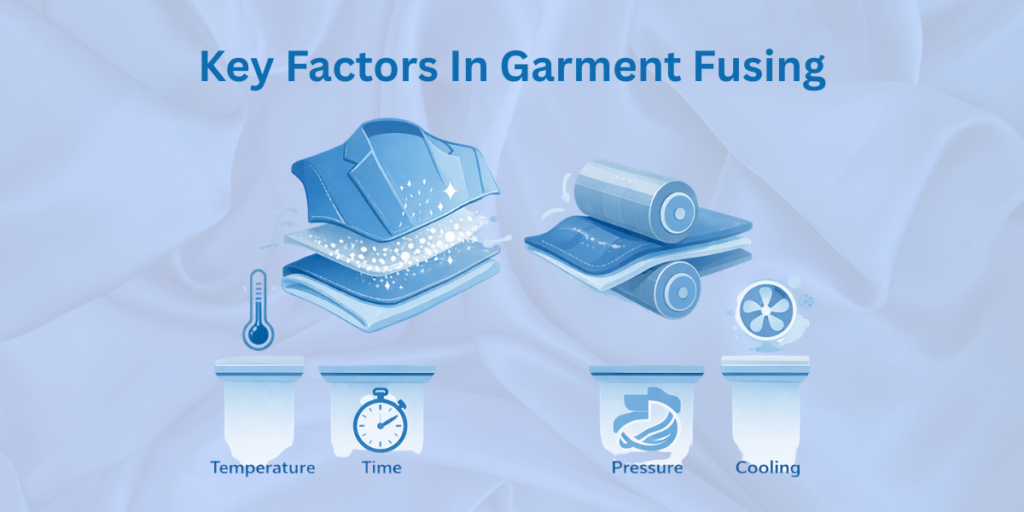
To obtain a bond that neither bubbles nor delaminates, four variables are to be controlled:
- Temperature: Most resin melts at 120 deg C to 150 deg C. If it’s too cold, it won’t stick. In case of excessive heat, the resin can strike back through the interlining.
- Time (Dwell Time): You need to give time to allow the heat to penetrate all the layers. This usually takes between 10 to 20 seconds.
- Pressure: This is applied to press the molten resin into the fabric pores. High-pressure rollers are used to ensure a uniform bond.
- Cooling: The bond is not permanent until the resin hardens. The layers do not move due to proper cooling.
Types Of Interlining Categories For Specific Garments
In Longhel Interlining, we have various interlining series according to particular bonding requirements. Every series is specified for specific fabrics and garments. The right decision helps in improving quality, whereas the wrong decision causes issues.
Business Suits (BS Series)
Suits require a structured and flexible bond. Our woven interlinings are of good quality to support strongly. They give you a chest piece impression without stiffness of the suit.
Shirts (DS & LS Series)
To have a crisp collar, the bond has to be firm. DS Series is best applied to formal shirts. The LS Series offers a more relaxed feel in casual wear.
These are shrinkage-tested. This prevents tightening of collars after washing.
Casual Jackets (JK Series)
Jackets have heavy shell fabrics. The bonding agent in this case should be strong to support the weight and feel of denim or heavy cotton.
Leather Clothing (LT Series)
Leather is hard to bond since it cannot withstand high temperatures. We have low-melt adhesives in our LT Series. These secure the leather and add the required structure.
Helpful Resource: Best Interlining for Garments: Complete Manufacturer Guide
The Science Of Adhesives: How It Actually Sticks
Various coating techniques are utilized by us to apply adhesive to our interlinings. The texture of the bonding fabric is based on the glue pattern.
- Double Dot: This is the gold standard. It uses two layers of resin. One of the layers is attached to the shell, whereas the other remains on the interlining. This eliminates “strike-through” (glue seeping out).
- CP (Computer Point): This is a mark that is at the exact position to make the fabric breathable and soft.
- Scatter Coating: This is more random and is applied to lower-cost or rigid reinforcements.
When To Choose Fusible vs. Non-Fusible
The selection is determined by the timing and the type of garment. Fusible Interlining is used where speed and uniformity are the main concerns. Modern mass production is supported by it.
Non-Fusible Interlining applies on heat sensitive fabrics. This can be velvet and synthetic furs. Interlining in these instances is also sewn rather than heat-bonded.
Fusible interlinings also decrease labor expenses and the time of production. They guarantee consistency in the bonding of large volumes. This suits them well in fast fashion and industrial manufacturing.
Non-fusible options have superior control and craftsmanship. They are used in luxury tailoring and custom clothes. The technique maintains the fabric texture and quality.
Common Challenges In Fabric Bonding
Even the finest manufacturers are challenged. The following is the troubleshooting of the bonding process:
1. Bubbling or Delamination
This occurs when the bond fails. It is normally the result of a lack of pressure or moisture on the fabric. It is important to always pre-shrink your fabrics and then bond.
2. Strike-Through
This is the time when the glue leaks up to the front of the garment. It ruins the look. To correct this, either reduce your temperature or use a Double Dot interlining of our professional line.
3. Color Change
Too much heat would burn sensitive fabrics or alter their color properties. Conduct a fusing test always on a small scrap prior to commencing a full production run.
Helpful Resource: Why Does the Interlining Bubble After Bonding
TL;DR
- Bonding fuses shell fabric and interlining to shape and strength.
- Fusible interlinings have thermoplastic resin as a permanent bond.
- Temperature, time, and pressure should be regulated.
- Longhel has a range of robes, suits, and so on.
- There is Double Dot technology, which avoids the leakage of glue.
Conclusion
The fashion world has a silent hero, bonding. It transforms flat material into long and durable clothes. This is an invisible process that shapes, makes modern clothes more stable and durable.
The process of selecting the interlining is critical to quality. The performance is enhanced with the help of options such as the CT Series of overcoats or the ST Series of stretch fabrics. They are used to make garments uphold structure, comfort, and flexibility.
Brand success in competitive markets is always characterized by quality. Longhel manages more than 30 million meters of annual output, which gives it consistency and scale. Safety and global trust are also guaranteed by OEKO-TEX 100 certification.
FAQs
Can I Bond Any Fabric To An Interlining?
Bonding of most fabrics is easily achieved. But low-temperature resins or non-fusible interlinings are required by heat-sensitive fabrics, such as PVC or fine silks. Test first before mass production.
How Do I Know Which Interlining Weight To Use?
The interlining must be equivalent to the shell fabric weight. It must be a little lighter or equal. This makes the garment well-balanced and comfortable.
Does Bonding Affect The Breathability Of The Garment?
The type of coating used determines breathability. Point seal and Double Dot finishes allow airflow. Full-surface coating hardens and lessens the breathability of garments.
Are Longhel Interlinings Safe For Skin Contact?
Yes, OEKO-TEX Standard 100 is met by Longhel interlinings. They do not cause any harm to sensitive skin. They can also be applied to infant clothes.
How Do I Test Bonding Quality Before Full Production?
A fusing test is always to be done on a small piece of fabric. This will assist you in testing the adhesion, color, and texture of fabric. It minimizes the risk and avoids expensive errors.
What Factors Affect The Durability Of A Bonded Garment?
Temperature, pressure, and quality of adhesives are dependent on durability. Correct cooling is also important in long-term performance. Proper bonding will mean that garments preserve shape even after washing.
Take a quote instantly and improve the quality of your garments with Longhel.